
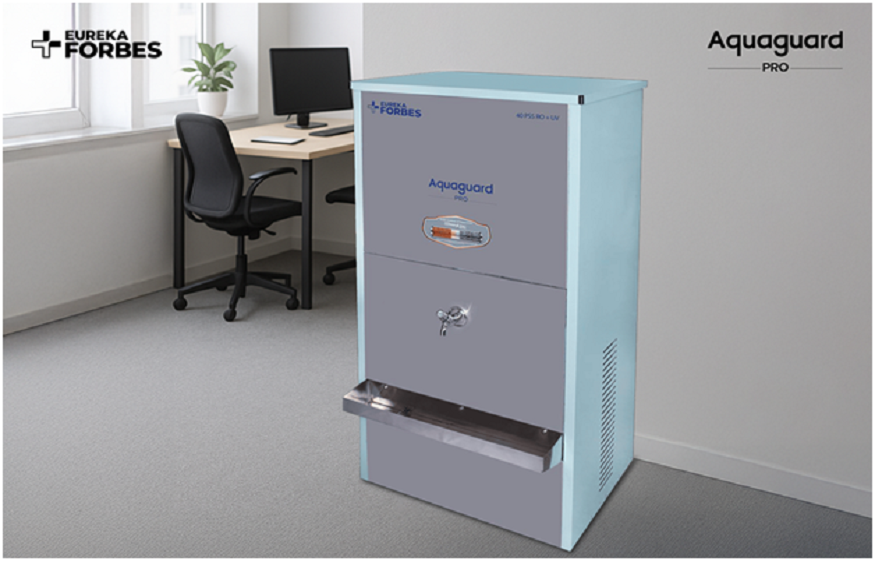
Clean and safe drinking water is a basic need, whether it’s for a home or a commercial space. Over the years, Reverse Osmosis (RO) water purifiers have become one of the most trusted and widely used solutions for water purification. However, commercial RO water purifiers are significantly different from home RO systems in terms of capacity, design, performance, and application.
Using a home water purifier, even multiple units, often fails to meet the daily water requirements of employees in a commercial setting. Understanding these differences can help businesses choose the right system and avoid underperformance or unnecessary costs.
1. Difference in Water Output Capacity
The most noticeable difference lies in water production capacity. Home RO systems are designed for small households and typically produce 10-15 litres per hour, which is sufficient for the daily drinking and cooking needs of a family.
In contrast, commercial RO water purifiers are built to handle large-scale demand. Depending on the model, they can produce 50 to 1000 litres per hour. This makes them suitable for restaurants, hotels, hospitals, schools, offices, factories, and industrial facilities where a continuous water supply is critical.
2. Usage and Application
Home RO systems are limited to domestic use, primarily for drinking and kitchen purposes. They are not designed to run continuously for long hours.
Commercial RO water plants, on the other hand, are engineered for heavy-duty, continuous operation. They are commonly used in:
- Food and beverage businesses
- Healthcare facilities
- Educational institutions
- Manufacturing units
- Commercial kitchens and cafeterias
These environments require consistent water quality and uninterrupted supply, which commercial RO systems are built to deliver.
3. System Design and Components
A home RO purifier is compact, wall-mounted, or countertop-based, and integrates easily into a residential kitchen. It typically includes sediment filters, carbon filters, an RO membrane, and a small storage tank.
Commercial RO water purifiers are larger, modular systems. They often include:
- High-capacity pre-treatment filters
- Industrial-grade RO membranes
- High-pressure pumps
- Stainless steel frames
- Optional UV disinfection stages
The robust design ensures durability, higher flow rates, and better performance under demanding conditions.
4. Water Quality Consistency
Both systems use the same core RO technology, which removes dissolved salts, heavy metals, chemicals, and microorganisms. However, commercial RO systems are designed to maintain consistent water quality even under fluctuating input water conditions.
This level of consistency is especially important for businesses such as restaurants and hospitals, where water quality directly affects food safety, patient well-being, and compliance with regulations.
5. Maintenance and Service Requirements
Home RO systems require basic maintenance, such as periodic filter and membrane replacement, usually once or twice a year.
Commercial RO water purifiers require professional maintenance, including regular performance checks, membrane cleaning, and pre-filter servicing. While maintenance costs are higher, they are justified by the system’s output, lifespan, and reliability.
6. Cost and Investment Value
Home RO systems are relatively affordable and designed for personal use. Commercial RO systems involve a higher initial investment, but they offer better long-term value for businesses by reducing bottled water costs, improving operational efficiency, and ensuring compliance with health standards.
7. Compliance and Safety Standards
Commercial RO water purifiers are often designed to meet industry-specific safety and water quality standards, making them suitable for regulated environments. This adds an extra layer of trust and accountability that home systems do not typically require.
For instance, the Aquaguard Prima 100-B Commercial Water Purifier is built for high-demand settings, delivering up to 100 litres of purified water per hour. Its 7-stage RO purification removes chemicals, microbes, and heavy metals, while automatic membrane flushing helps maintain hygiene with minimal manual effort. With 50% water recovery and a tankless, direct-line design, it works well in spaces where water demand is continuous.
For smaller businesses, the Aquaguard Reviva 50 LPH Commercial Water Purifier offers a more compact solution. It comes with 6-stage RO purification, a 50-litre storage tank, and a self-cleaning system to ensure consistent water quality, even during power cuts. Its space-saving design makes it suitable for offices, schools, small factories, and institutional kitchens.
Final Thoughts
Home and commercial RO water purifiers use the same purification technology, but they are made for different levels of demand. Home RO systems are suitable for limited household use, while commercial RO water plants are meant for businesses that need large quantities of safe water throughout the day.
Choosing a system based on actual water usage helps improve performance, control costs, and ensure long-term reliability, so clean water remains consistent and dependable.